
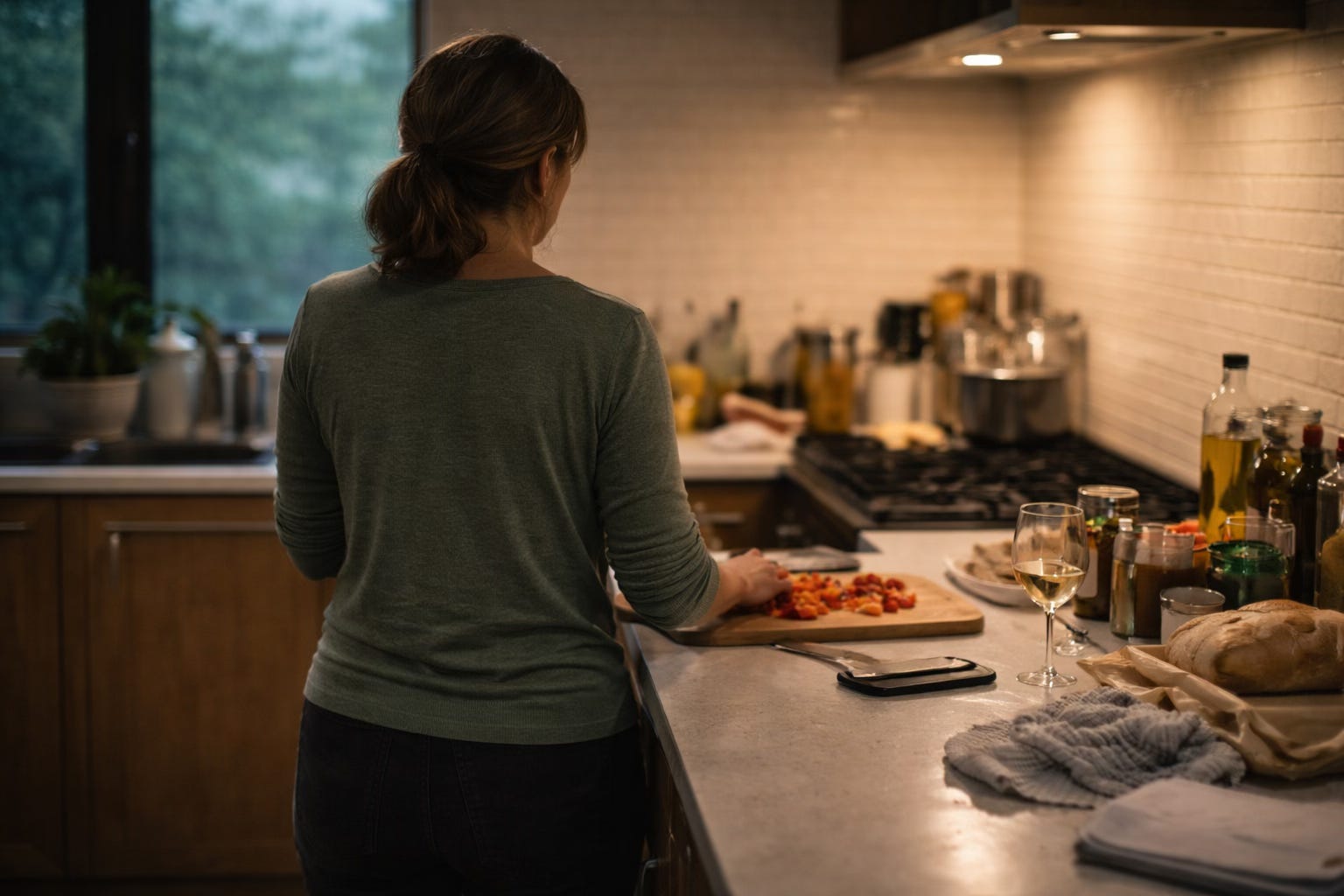
It was a Friday night — the kind where everyone is a bit tired, a bit stretched, and everything feels slightly louder than it should.
My daughter was meant to cook. That’s the agreement, Friday nights are hers. But she was already off — snappy, dragging her feet, saying she didn’t feel like it.
My husband was hovering, half-ready to step in and just get dinner sorted so it didn’t turn into a whole thing.
And I could feel that pull to just let it go. It would have been easier, faster, less friction. Nobody would have had to feel anything uncomfortable for more than five minutes.
But I also knew exactly what would happen if I did.
We’d teach her that she only has to follow through when she feels like it. That someone else will carry it when she doesn’t.
So instead of jumping in, I stayed where I was — not rigid, not annoyed, just steady.
I said something simple: “I get that you don’t feel like it. You still said you would.”
She pushed back. Of course she did — a bit of attitude, a bit of testing. This is usually where things either escalate or collapse, where I over-explain or take over or both.
But I didn’t add more words or rescue her or turn it into a lecture.
I just held it.
The kitchen went quiet. Some sighing, a bit of noise, my husband looking at me with that expression that says — are we really doing this? And I stayed steady.
Eventually, she started. Not enthusiastically, not perfectly, but she did it. And something shifted halfway through. She got into it, asked a question, took ownership in a way she wouldn’t have if I’d stepped in.
It didn’t look like leadership.
It looked like a tired family on a Friday night, and a mum who wouldn’t let things quietly collapse.
I’ve been thinking about how many moments like that one there are.
Not just the obvious ones — the difficult conversations, the decisions that have names and weight. But the quieter ones. The Friday nights. The moments where nobody is watching and nothing gets recorded and the whole thing will be forgotten by morning.
The moments where something still has to be held.
For most of my career I was taught to think of leadership as something that happened in particular places — meeting rooms, performance conversations, situations with stakes and visibility and an audience of some kind.
What I’ve come to understand is that the most consequential leadership most of us do happens somewhere else entirely.
It happens in the five seconds before you decide whether to rescue or hold.
In the silence after you’ve said the thing and someone is pushing back.
In the moment your husband looks at you and you stay steady anyway.
The skills that Friday night required were not domestic skills.
I could feel exactly what was happening with all three of us before a word was said. I knew that adding more words would make things worse, not better. I knew that stepping in would solve the immediate problem and create a larger one. I knew how to hold something without becoming rigid about it.
These are the same skills I spent twenty-nine years developing inside organisations.
I just never thought to call them that when I used them at home.
And I don’t think I’m unusual in this. Most capable women have been doing this work — the reading, the regulating, the holding, the knowing when to step in and when to stay still — in their homes and relationships for as long as they have been doing it in their careers.
They just haven’t been calling it leadership.
Because nobody told them it was.
There’s a cost to that unnamed work.
Not because it goes unappreciated — though sometimes it does. But because when we don’t recognise our own leadership, we can’t understand where our energy is actually going. We wonder why we’re tired at the end of a Friday night when we didn’t do anything particularly hard. We can’t see that we’ve been leading all day — in both rooms, often simultaneously — and that it draws from the same place regardless of which room we’re in.
Understanding how you are built to lead doesn’t just change how you show up at work.
It changes how you see yourself at home. The way you read a room before anyone’s spoken. The instinct to hold something rather than rescue it. The capacity to stay steady when everyone else is waiting for you to move.
Those aren’t habits you developed.
They’re patterns you’ve always had.
And they’re worth understanding — not so you can optimise them or do them more efficiently or find a better system for your Friday nights.
Just so you can finally see them for what they are.