
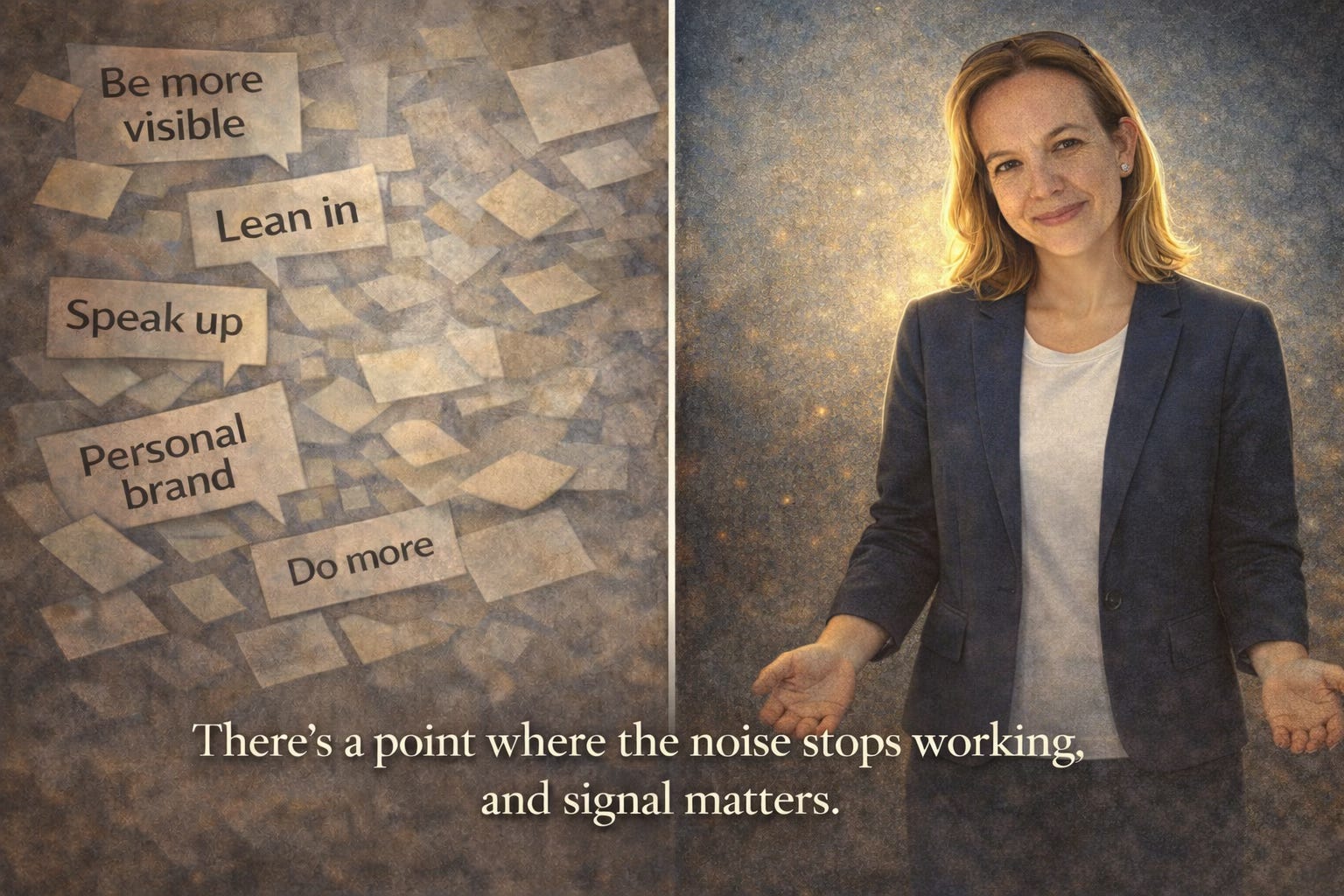
There was a point in my career when I was told I needed to work on my executive presence.
It was said kindly. It was framed as investment — in me, in my development, in helping me be heard more effectively. And on the surface, it was hard to argue with. I was on a high-profile project that wasn’t going well. I had been escalating issues for weeks. The right people weren’t acting on them. And so the feedback made a certain kind of sense: if your input isn’t landing, the problem must be how you’re delivering it.
So I took it seriously. I worked on being more vocal in meetings. I practised giving my opinion more directly, more visibly, more in the style that seemed to carry weight in that room. It was exhausting in a way that was difficult to explain — not because the effort was enormous, but because every bit of it ran against my natural instinct. I was performing a version of myself that felt slightly off, like wearing shoes that weren’t quite the right size. Functional. But not mine.
What I couldn’t see clearly at the time — and what took me years to properly name — was that the room wasn’t asking for my presence.
It was asking for my silence.
The project had been started without the correct foundations. The people in that room knew it. I knew it. What I didn’t fully understand was that my escalations weren’t failing to land because of how I was delivering them. They were failing to land because landing them would have required someone to admit that decisions made before I arrived had been wrong. And nobody in that room was prepared to do that.
Executive presence, in that context, was not a development opportunity.
It was a mechanism. A way of making the woman who kept pointing at the problem into the problem herself. Tidy. Deniable. Almost impossible to argue with, because it sounds so reasonable. So invested in you.
I did try. I stretched into what was being asked of me. I was vocal. I gave my opinion — the one they didn’t want to hear — in every register I could find. More directly. More confidently. More visibly. None of it changed anything, because the thing that needed to change was never me.
Eventually I left. The project continued.
I don’t tell that story as a grievance. I tell it because it took me a long time to understand what had actually happened — and even longer to see how common it is. The advice that sounds like support but quietly repositions you as the variable. The feedback that turns your clarity into a presentation problem. The development opportunity that asks you to become louder in a room that has already decided what it wants to hear.
There is a point where the noise stops working. Not because you’ve stopped growing, or lost ambition, or need a better strategy.
But because you’ve finally started to hear what the noise was always covering up.
The problem was never your presence.
It was that you could see something they couldn’t afford to acknowledge.
And that — in my experience — is not something executive presence training fixes.