
Laptop closed, but I’m still at my desk. Replying to one last Teams message on my phone. Then checking email — quickly, I tell myself. It’s never actually quick.
Eventually I stand up because I have to. Usually because I can hear something happening in the house — my daughter, the TV, someone in the kitchen.
I walk out still half in work mode.
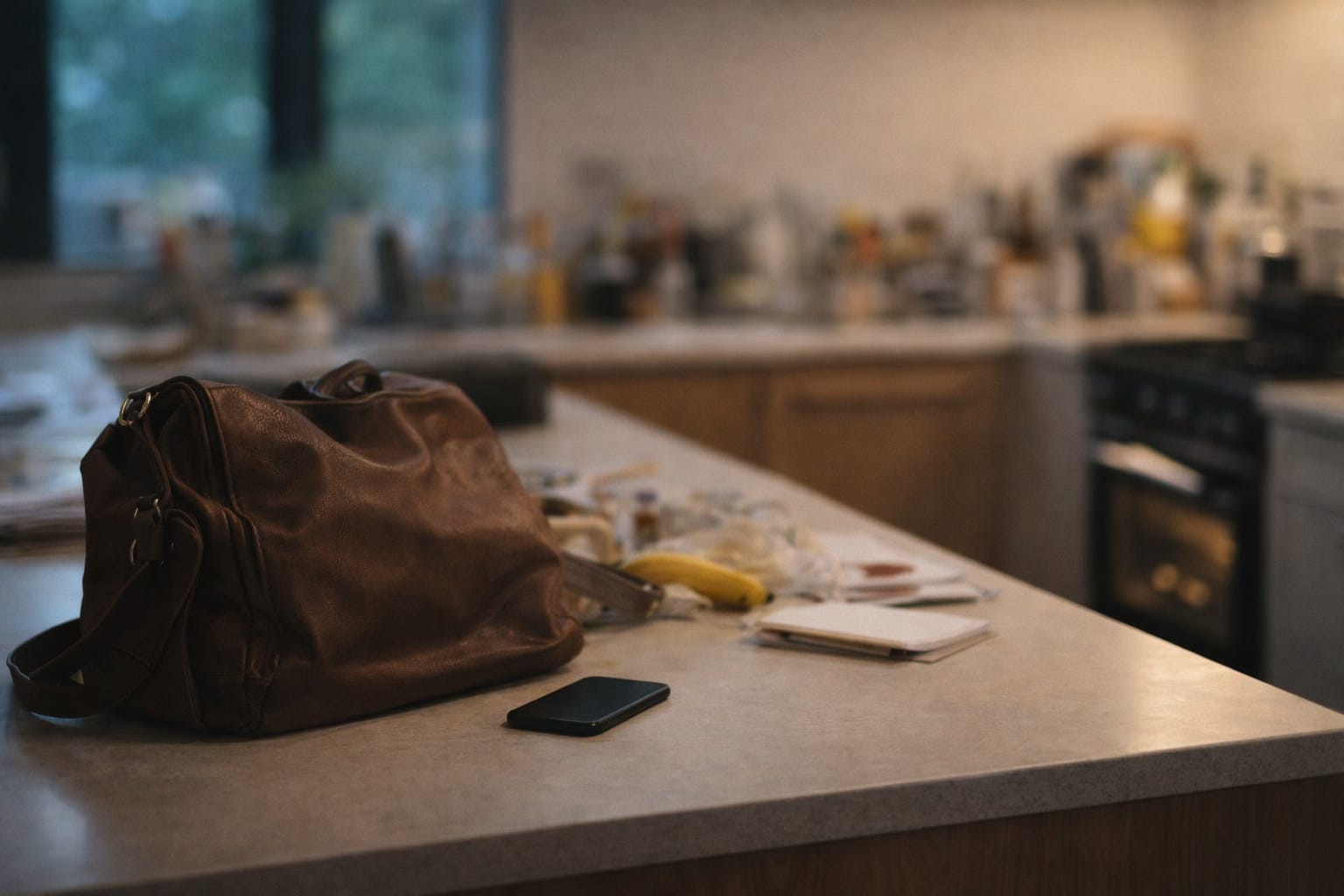
First thing I do is go straight to the kitchen — not intentionally, it’s just where everything lands. Bag on the bench, phone still in my hand, opening the fridge without really knowing what I’m looking for.
Someone asks me something. “What’s for dinner?” Or “Can you help with this?”
I answer, but I’m not fully there yet. Still somewhere in a conversation from work, or a decision I didn’t quite finish, or something that’s sitting unresolved at the edge of my thinking. I can feel it in my body — like I’m slightly ahead of myself. A bit wired. Slightly impatient. Not in a bad mood, just not settled.
The reset, when it comes, is never graceful.
It’s something small and physical. I change out of my work clothes. Or I tie my hair up. Or I put my phone down because I need both hands.
That’s when it shifts.
My body drops a gear. I start doing something practical — chopping, unpacking bags, putting washing on. And that’s when my head catches up.
By the time I’m properly into making dinner, I’m back. Present. Responding properly. Not half-listening.
I used to think of that transition as a failure of discipline.
That I should be better at leaving work at work. That a more organised version of me would have a clear handover ritual — a walk, a meditation, a specific moment where one thing ended and another began. I’d read about those rituals. I’d tried a few. They worked for a week and then dissolved back into exactly what I just described.
What I eventually stopped doing was calling it a problem.
Because when I looked at it more honestly, what was actually happening in those twenty minutes between the laptop and the dinner wasn’t a failure of transition. It was just one woman, moving through two completely different sets of demands, with the same nervous system and the same reserves she’d been drawing on all day.
The work version of me and the home version of me are not two different people.
They’re the same person. With the same patterns, the same pace, the same need for a moment to settle before she can be fully present. The same tendency to need something physical and practical before her head catches up with where she actually is.
This is what nobody says about the leadership women do at home.
It’s not separate from the leadership they do at work. It draws from the same place. The same capacity for reading a room, managing emotional temperature, holding things together when several things need attention at once. The same ability to sense what’s actually going on underneath what someone is saying. The same quiet judgement about when to step in and when to let something unfold.
At work, that’s called leadership.
At home, it’s called being a mother. Or a partner. Or just — managing the household.
But it’s the same muscle. And when it’s been in use all day, it doesn’t suddenly refill the moment the laptop closes. The depletion crosses the threshold with you. It follows you to the kitchen. It’s there when you open the fridge without knowing what you’re looking for.
The reason so many capable women feel perpetually behind at home — not doing it well enough, not present enough, not patient enough — isn’t because they’re failing at the domestic version of their lives.
It’s because they’ve been running on the same reserves all day, for both things, without ever naming it.
Understanding how you are built doesn’t make the demands lighter.
The back-to-back meetings still happen. The “what’s for dinner” still lands before you’ve properly arrived. The transition is still physical more than graceful.
But something shifts when you stop treating your own patterns as problems to fix.
When I stopped trying to manufacture a clean handover between work and home, and started understanding that my body drops a gear through physical activity — not meditation, not a walk, not a ritual I read about — the guilt about the twenty messy minutes began to ease.
Not because I fixed them. Because I understood them.
And from that understanding, something quieter became possible. I stopped arriving at dinner already behind. I stopped measuring the transition against a version of it I’d seen somewhere else and concluding I was doing it wrong.
I just let it be what it is.
A woman, moving through her whole life, with one design.
Doing the best work she knows how — in both rooms.